Apple did something very uncharacteristic of them in their much ballyhooed "It's Showtime" event. They preannounced a product two quarters before it will ship. Forget the iPod announcements, the product code named, iTV, has the potential to do what Microsoft could not with Media Center: replace the set-top box. There are other appliance-type boxes out in the market that download and store content for playback, but what makes iTV a serious contender is that it comes from Apple.

Anyone in marketing or technology realizes that Apple has mastered the art of marketing. They are able to gain an almost religious following because they understand the concept of whole product. For those of you not familiar with marketing and product management concepts, the whole product is not just a specific box, piece of software, or service. It includes the whole ecosystem surrounding the product that delivers utility to the consumer. Couple this concept with a coolness factor, add some mystique, and you have a category hit on your hands.
Apple's 75% plus marketshare in portable music players is no mistake. Apple successfully accomplishes what Microsoft struggles to do...they made it easy for the average consumer to buy, store, and play music on the go even with mediocre hardware quality. You do not have to be a computer genius with knowledge of MP3 and AAC encoding, USB, virtual drives, and digital rights management (DRM) to take your music on the go. All you have to do is to plug your iPod into the supplied cables, fire up iTunes, and purchase your music at the iTunes Music Store. Apple takes care of the rest. While the geeks and techies were arguing about DRM, encoding restrictions, and batteries, consumers were downloading millions of songs from the iTunes Music Store. They make cool products. Even the packaging is cool. This attention to design is a must for any consumer product. Apple's marketing genius combined with a thorough understanding of the process consumers use to purchase content makes them envy of any product manager trying to introduce a successful new product in an overcrowded marketplace. You bet several product managers in Redmond are green with envy. It is these magic beans that makes the iTV a potential market disrupter to the set-top box market.
 The iTV picks up where the set-top box leaves off. A consumer can purchase this box, available 1Q07, for $299, plug it in, turn it on, and start enjoying rich multimedia on their TV and audio system. No external clunky PC with Microsoft's Media Center is required. Just a nice, neat appliance with a sexy user interface delivering movies, TV shows, music, podcasts, and photos. Nothing from Motorola or Scientific Atlanta even comes close to date. TiVo and Moxy are contenders but they are missing the mobility/portability factor.
Content comes through the iTV's built-in wireless network interface, probably based on 802.11a/b/g until 802.11n is fully standardized, so it can be placed in the entertainment center without trying to figure out how to run Cat5 cable to it. Apple did not disclose whether a hard drive was built in to the unit so I assume that a modest one is included so it could store and display content without the help of another PC. If not, then one can easily be connected through the USB 2.0 port on the back of the unit. Otherwise, media can be streamed from any PC or Mac running iTunes sharing their content. It has component video or HDMI connectors for connecting to a conventional or High Definition TV set.
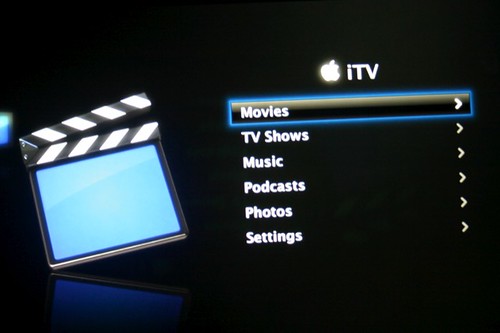
 The user interface is characteristically Apple. It looks like FrontRow supercharged and crossed with Media Center. Movies, TV shows, music, podcasts, and photos on the iTV or any other computer running iTunes are available without DRM worries. You can purchase a TV show from the iTunes Music Store that downloads to iTV but you don't have time to watch it all. Just fire up iTunes on your PC and move it to your iPod. Maybe you can connect the iPod to the iTV. Take that Comcast! I do this all of the time with podcasts. I start listening to them on the PC, then move to the living room where they are streamed to my AirPort Express before finishing them up on my phone while doing yard work.
So what makes the iTV a threat to the traditional set-top box? There are technical, marketing, and business reasons. Let me explain:
- Apple's ability to sell a whole product or whole solution is a proven formula for success. They provide the complete ecosystem from providing access to the content all the way to enjoying the content in a simple almost non-technical way that brings the product into the mainstream beyond the early adopters.
- Apple is a name brand with a reputation for cool and quality products. Their reputation for quality and innovation is beginning to surpass Sony's! Can you say, marketing muscle?
- Movies, TV programs, music, podcasts, and pictures can be enjoyed on a PC, iPod, or iTV. It is truly portable and mobile. The cablecos and telcos are still wrestling with the mobility/portability problem. Verizon is just beginning to lighten up and allow recorded programs to be viewed on multiple TV with their new Motorola set-top boxes, but not on computers.
- They provide integrated content delivery beyond video. Apple is not dependent on cablecos or telcos to provide access to content. They have their own deals with content providers like Disney. Although this may threaten cablecos and telcos, they are missing real-time content.
- The iTV is similar to a set-top box so users will immediately understand how to connect it to their entertainment system. No external PC with Microsoft Windows OS that requires constant care.
- Internet content will now be available on the TV. Listen to downloaded music, podcasts, and video content from the Internet. Only TiVo has this capability now.
If Apple's marketing machine can leverage these benefits without directly taking on the video content distributors, then they will have their next hit on their hands and drive content revenue through iTunes. I know that I will buy one if they do it right. Also, I'll cancel my NetFlix subscription and stop purchasing OnDemand movies.
Adding a tuner and supporting OpenCable Application Platform (OCAP), or minimally CableCARDS, would provide real-time video content that the iTV is missing. With the DVR and on-screen program guide, Apple now has a superior solution to Motorola and Cisco even with their TiVo and Digeo partnerships. The cable companies will quickly jump on the bandwagon because they would no longer have to supply costly set-top boxes; thereby, reducing their capital and operating expenses. This is the objective that they have been driving towards for years. Consumers would love it because they could save on their cable bill and most importantly have a choice where to acquire content. If the cable companies are worried about Apple cutting into their content revenue, I am sure that Apple would create cableco specific branches of the iTunes Music store that integrated with the cableco on-demand content.
I am confident that Jobs and company have already thought of adding these features, and they will include a version with integrated cable with the release of iTV. Apple's understanding of marketing combined with content mobility gives them the opportunity to be the first successful consumer purchased set-top box. Motorola and Cisco have a long way to go to catch up in features and cost. Look for some serious competition in this market in 2007-8.
If Apple can strike a deal with Comcast, I will gladly relinquish my Motorola DCT6412 (soon to be a DCT3412) and move my AirPort Express to the bedroom. Can I have it by February Steve?
All pictures in this article courtesy of Engadget.
Tag: Apple (APL), Motorola (MOT), Cisco (CSCO), Comcast (CMCSA), Verizon (VZ)